
Caroline County Parole Versus Probation
Parole and probation both permit a person to live in the community under rules, but they begin in different ways. In Caroline County, a circuit judge orders probation. It can follow a jail or prison term, or it can be part of a suspended sentence. Parole is release authorized by the Virginia Parole Board for a person who is legally eligible. VADOC administers both forms of state community supervision through probation and parole districts.
The difference matters when reading a record. A person on parole has left prison under a Board-authorized plan, yet the sentence has not reached final discharge. A person on probation follows court-imposed terms, which may start after incarceration or without a prison release. A district-office entry in the VADOC Inmate and Supervisee Locator can support that physical custody ended while state supervision continues.
Pretrial release is a third category. It occurs while a criminal case is pending and may require local monitoring, but it is not probation imposed as part of a final sentence. Likewise, transfer from Pamunkey to VADOC is not parole. It changes the custodian. These distinctions prevent a current jail absence from being mistaken for the type or end of Caroline County supervision.
| Point | Parole | Probation |
|---|---|---|
| Who authorizes it | Virginia Parole Board for an eligible case | Circuit court judge |
| When it begins | After release from prison | As ordered by the court, sometimes after incarceration |
| Who supervises | VADOC community supervision | VADOC for state probation; local services handle distinct local programs |
| How it ends | Final discharge from parole | Completion or court-approved termination of probation |
- Supervision
- Rules and reporting duties that apply while a person lives in the community.
- Discharge
- The formal end of custody or supervision, not merely departure from a prison or jail.
- Absconder
- A person alleged to have stopped reporting or otherwise left supervision without authorization.
- Detainer
- A request by another authority to hold or take custody of a person.
Verify Caroline County Post-Release Supervision
Start with the last known legal event. A Pamunkey Regional Jail departure may be bond, time served, transfer, or another event that has nothing to do with parole. A VADOC prison departure may lead to parole or probation, but it can also be a full discharge. The locator covers people in current VADOC custody or supervision. It is not a permanent archive of all former supervisees.
- Search the VADOC locator with at least the first three letters of the first name and the full last name, or use the seven-digit DOC ID.
- Compare DOC ID, age, and location. A district-office location may indicate community supervision, while a prison location indicates incarceration.
- Read the custody or parole status exactly as displayed. Do not treat a missing result as proof of final discharge.
- Confirm Caroline service through Ashland District 41 and ask what public status the office can provide.
- Check the Caroline Circuit Court case for a probation order or later revocation entry. For parole, consult the Board’s published decision sources.
- Request the existing discharge or status record from the office that maintains it when the online sources do not settle the question.
The Caroline County released-inmate search paths help separate a Pamunkey release, a VADOC release, and a transfer. That distinction should come before any supervision conclusion. Court action gives the legal basis, while the supervising agency gives the current status.
Caroline County State Supervision Office
Ashland District 41 is the VADOC office assigned to Caroline County. The state directory says it also serves Hanover County and the Town of Ashland. Fredericksburg District 21 may seem closer for some residents, but the official VADOC service listing does not assign Caroline there. Use the named district, then verify the specific record before relying on a location shown by a dynamic search.
103 Green Chimneys Court, Suite A
Ashland, VA 23005
804-368-3846
VADOC facilities and offices directory
The official directory image below shows the source used to assign Caroline County parole and probation matters to District 41. Check the current VADOC directory before making contact.
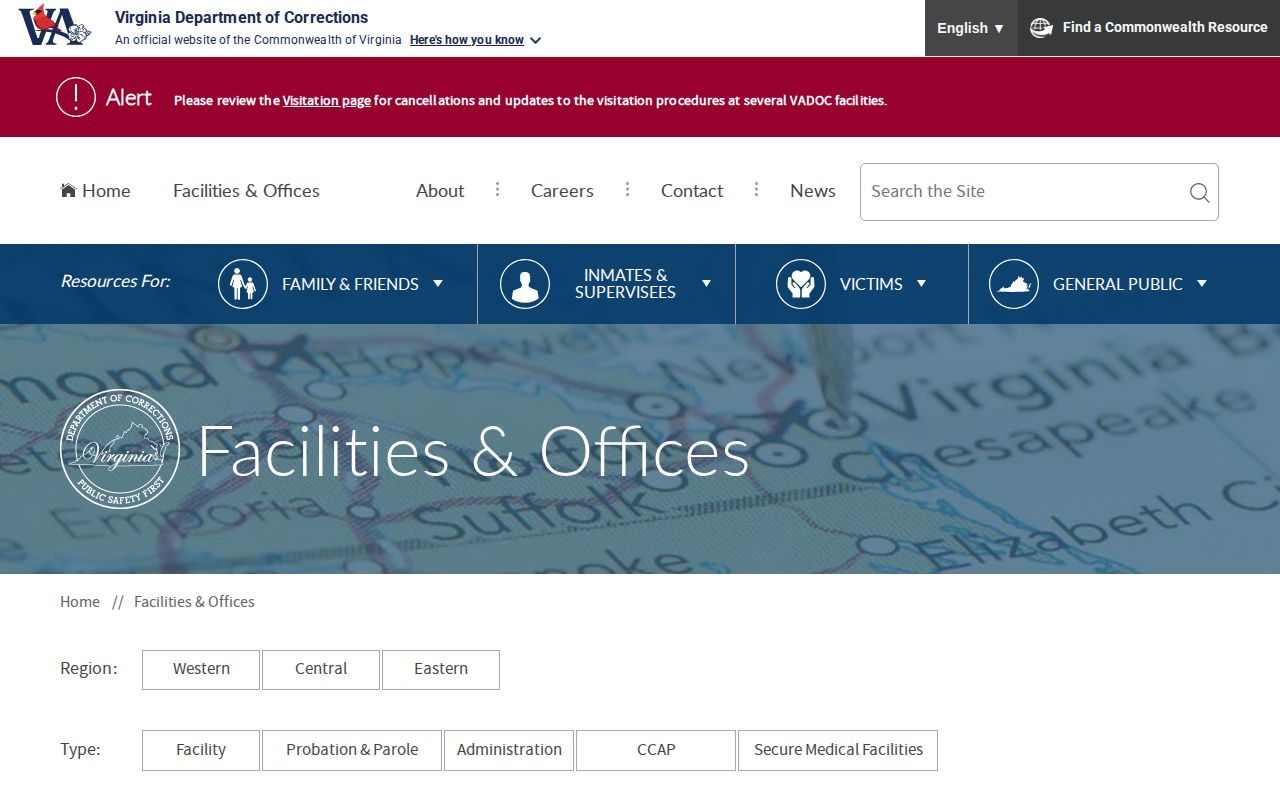
This office assignment separates state parole and probation from local pretrial services and helps prevent calls to the wrong district.
Caroline Supervision Warrants and Violations
Conditions are the rules attached to supervision. The signed Conditions of Probation or Conditions of Parole are the controlling documents for the individual. A reported breach can lead to investigation, a court capias, a parole warrant, revocation proceedings, or another response authorized by law. A capias is a court order directing that a person be taken into custody. A violation report is not a new conviction, and a warrant listing does not prove that the person has already been arrested.
The VADOC Most Wanted page is a limited public channel. VADOC says supervision-related PB-15 warrants, court capiases, and Parole Board warrants are filed with state or local law enforcement. The page is not a complete list of every active case. Absence from it proves neither compliance nor the absence of a warrant. If a listed person is recognized, use the contact method shown by the agency and do not approach the person.
Virginia Jail VINE and NAAVI serve notification functions, but they are separate systems. Local-jail events fed by Pamunkey may appear in Virginia Jail VINE. VADOC custody and supervision events use NAAVI. Neither replaces a court record, a warrant confirmation, or the assigned officer’s official record.
Note: A supervision allegation, wanted listing, and completed revocation are different events and should never be treated as the same record.
How Caroline County Supervision Ends
Leaving a correctional facility is not the same as leaving supervision. Parole continues until a formal final discharge. Probation continues for the term and under the conditions set by the court unless the court changes or ends it. A locator no-result may occur after full discharge, but it may also reflect a name issue, timing, an interstate transfer, or no VADOC involvement. Seek an existing discharge document or direct status confirmation rather than inferring the result.
VADOC release processing can include an Order of Release, Conditions of Probation, Conditions of Parole, and a notification-of-release letter. Those papers distinguish the physical exit from the rules that follow. Virginia law also permits VADOC to withhold designated probation and parole records, so public confirmation can be narrower than the complete case file. Ask for the specific date or status record needed and request a statutory citation for any withheld part.
Two Caroline Supervision Systems
Caroline County has a local layer that must not be confused with state parole or probation. Hanover Community Corrections and Pretrial Services serves Caroline for local pretrial and community-corrections work. Its office is at 9714 Atlee Commons Drive, Ashland, VA 23005, and its phone is 804-365-6873. Posted hours are Monday through Friday, 8:30 a.m. to 5:00 p.m.
A defendant ordered to pretrial supervision must report right after release. That event is usually tied to bond and a case that remains pending. It is not parole and does not mean the sentence has ended. The research states that pretrial supervision itself has no fee, though a court-ordered service may have a cost. Noncompliance can lead to bond revocation or contempt. Local probation may charge up to $150.
| Caroline County path | Office | Record meaning |
|---|---|---|
| State parole or probation | VADOC Ashland District 41 | Current state community supervision |
| Pretrial release | Hanover Community Corrections | Community monitoring while the criminal case remains pending |
| Local community corrections | Hanover Community Corrections | A local court-based alternative, distinct from state parole |
This office split is the distinctive Caroline County detail: District 41 handles VADOC supervision, while Hanover Community Corrections handles the local programs. Calling Fredericksburg District 21 based on geography would bypass the office that VADOC assigns to Caroline.
Each office also answers a different record question. District 41 may confirm public VADOC status tied to an assigned state case. Hanover Community Corrections can address its own pretrial or local program records. The Caroline court docket remains the source for the judge’s order. Ask each custodian only for the existing record it maintains, and do not assume that one office can certify the other system’s work.
Caroline Parole Decision Sequence
The Virginia Parole Board decides discretionary parole for people who remain eligible under Virginia law. Ordinary discretionary parole was abolished for most felonies committed on or after January 1, 1995, though statutes preserve defined exceptions. A hearing, interview, or eligibility date does not mean parole was granted. Even a grant starts a later release process rather than proving that the person has left prison.
The Board publishes public meeting information and monthly decision reports. The calendar is not a complete list of all parole reviews. Published reports can state the person, offense, jurisdiction, sentence data, time served, grant or denial, reasons, final vote, and members voting. Reports appear only after required notice steps, with the posting timing described by the Board.
The sequence is eligibility or consideration, Board action, grant or denial, VADOC date setting, physical release, community parole, and final discharge. Under Virginia Code § 53.1-136, VADOC generally sets a granted release no sooner than 30 business days after receipt of the chair’s notice, subject to the statute’s conditional-release provisions. The VADOC release record, not the decision report alone, confirms departure.
Note: “Granted” records Board approval; it does not establish the date when VADOC completed physical release.