
Caroline Projected Versus Actual Release
A projected date is a live sentence calculation. It uses the controlling sentence, credit earned so far, prior jail credit, and other legal or administrative facts. “Tentative,” “projected good-time,” “projected mandatory-parole,” and “parole eligibility” are not interchangeable labels. Eligibility marks when a person may be considered. A good-time date reflects a credit calculation. The actual release is the event when the custodian completes processing and the person leaves that authority’s physical custody.
Caroline County has more than one path. Pamunkey Regional Jail handles local and regional jail custody. VADOC computes qualifying state sentences and publishes limited current information. Caroline Detention Facility belongs to the ICE system, and federal sentences belong to BOP. A transfer between authorities ends one facility’s control but is not necessarily release to the community.
A pretrial Pamunkey detainee often has no computed sentence-release date. Bond, dismissal, a plea, sentencing, a court order, or a separate hold can control what happens next. The court docket explains the legal order, while Pamunkey confirms when jail processing ends.
A locally sentenced person can have a calculation, but it is not automatically a VADOC calculation. VADOC states that it calculates active earned-sentence-credit terms longer than 12 months. That boundary makes the sentence holder and sentence length relevant before a Caroline County projected release date is sought. Records staff can identify the office that owns the current computation.
Find Caroline County Projected Release Dates
The first task is to identify the sentence holder. A Caroline arrest alone does not show whether Pamunkey, VADOC, ICE, or a federal agency now has responsibility. Search the official system tied to the last known custodian, then preserve the exact field name and access date. The Caroline County released-inmate search explains the wider custody chain when the responsible agency is unclear.
- For a state prisoner, open the VADOC Inmate and Supervisee Locator. Search by the seven-digit DOC ID or by name, then compare ID, age, and location.
- Read the exact result label. VADOC staff may confirm projected parole-eligibility, projected mandatory-parole, and projected good-time release dates when public.
- For a local sentence at Pamunkey, contact Records or the staff responsible for local sentence computation. Ask for the current projected date and the sentence or order that controls it.
- For a pretrial person, check the Caroline court docket and bond order. Do not invent a sentence date where no sentence exists.
- Ask about warrants, detainers, consecutive terms, and receiving authorities. Each may affect whether the date ends all custody.
- Confirm completion with the actual release record, notification-of-release letter, or agency status notice after the date arrives.
The VADOC locator page below is the official state starting point and states that the data updates daily but may be inaccurate or out of date.
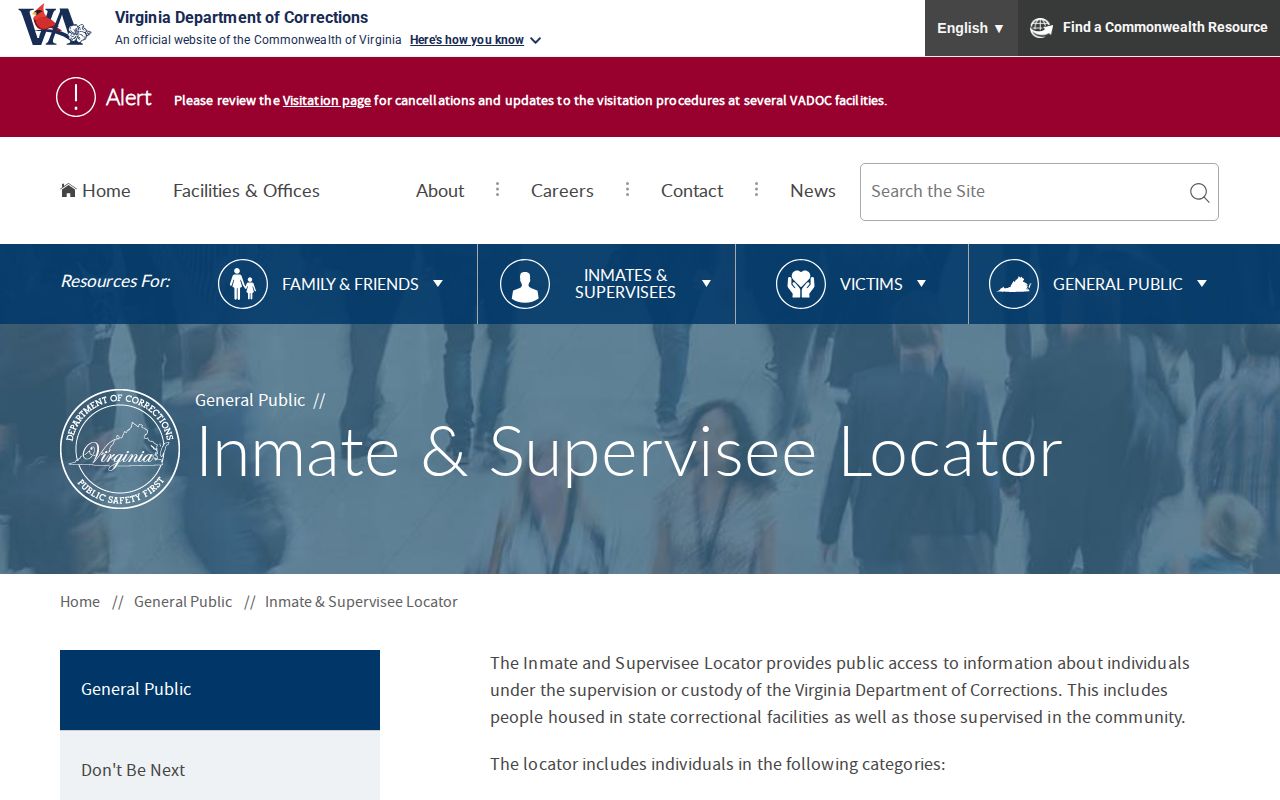
Its custody and supervision scope is useful, but it is not a permanent archive for people who are fully discharged.
Virginia Earned Sentence Credits
Virginia’s modern earned sentence credit system applies to felony offenses committed on or after January 1, 1995. Under Virginia Code § 53.1-202.2, credits are sentence deductions earned through rule compliance, required program participation, and other legal or regulatory criteria. Credits change the projected end date. They do not change the sentence imposed by the court.
Section 53.1-202.3 divides modern cases into two groups. ESC-1 covers the offenses listed in subsection A and permits no more than 4.5 credit days for each 30 days served, subject to level. Eligible ESC-2 cases may earn 15 days per 30 at Level I, 7.5 at Level II, 3.5 at Level III, or none at Level IV. The offense and the person’s credit level both matter.
Placement reflects program, work, education, conduct, and operational criteria. Infractions or a level change can alter future credits. Section 53.1-202.4 addresses how credits apply and may be forfeited. VADOC also identifies prior jail credit, sentence type, the total term, disciplinary events, and other facts as parts of an individual calculation.
The official VADOC Time Computation page presents the ESC and older GCA systems side by side.
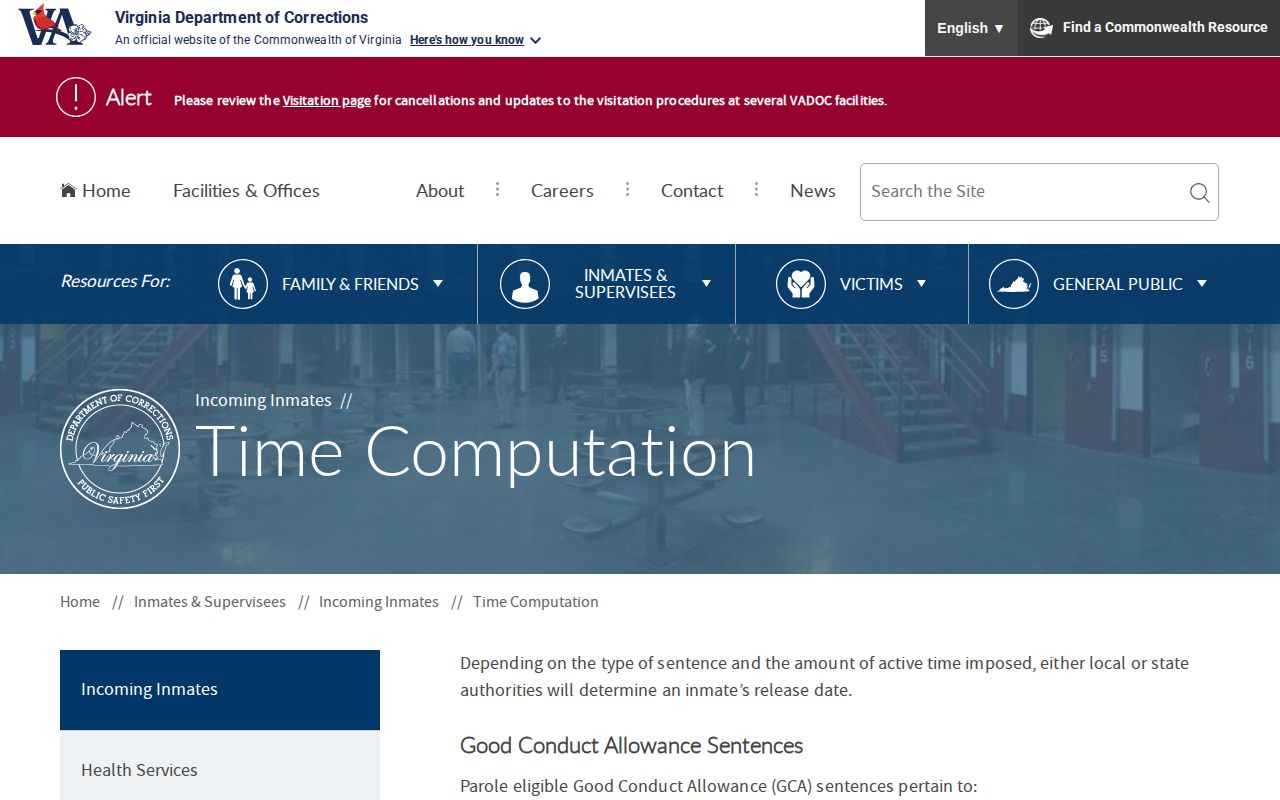
The separation shown there is critical because applying the wrong credit system produces the wrong projected release date.
Why Caroline Release Dates Change
A date can move before release because the inputs change or an error is corrected. Some changes affect the calculated sentence end. Others affect where the person goes on that date. A detainer, for example, may cause another authority to receive the person even when the first custodian’s term has ended. It should not be described as an ordinary community release.
| Factor | Effect on the date or exit |
|---|---|
| Prior jail credit correction | Changes time credited before VADOC admission. |
| Concurrent or consecutive terms | Changes how multiple sentences overlap or follow one another. |
| Credit level or forfeiture | Changes how fast earned sentence credit reduces the term. |
| New court order | May revise the controlling sentence or legal authority. |
| Parole action | May authorize a later release process in an eligible case, but a grant is not the exit itself. |
| Detainer or warrant | May send the person to another authority instead of the community. |
| Administrative correction | May fix source data or a computation error. |
VADOC warns that locator data can be inaccurate or outdated even though it updates daily. Record the date shown and when it was checked. For a major change, ask the agency to identify the current calculation rather than relying on an earlier screenshot or notice.
Note: A new projected date replaces an earlier estimate; it does not rewrite the actual release record once departure has occurred.
Confirm Caroline County Release Completion
Use notification systems as alerts, not certified ledgers. Virginia Jail VINE covers participating local-jail records, including events sent by Pamunkey. NAAVI is a separate VADOC system. Its advanced release notice is an anticipated event, while its release-date notice indicates that VADOC custody ended. A person transferred from Pamunkey to state custody may require registration in both systems.
The Virginia release-notification steps explain how to follow one named person. After an alert arrives, confirm the event with the custodian. For Pamunkey, ask Booking/Release about current public status and seek the booking-and-release record from Records. For VADOC, the notification-of-release letter, Order of Release, applicable Conditions document, or DC-366 certification provides stronger proof than an anticipated notice.
The official VADOC Facility Release page describes the paperwork issued at discharge or parole.
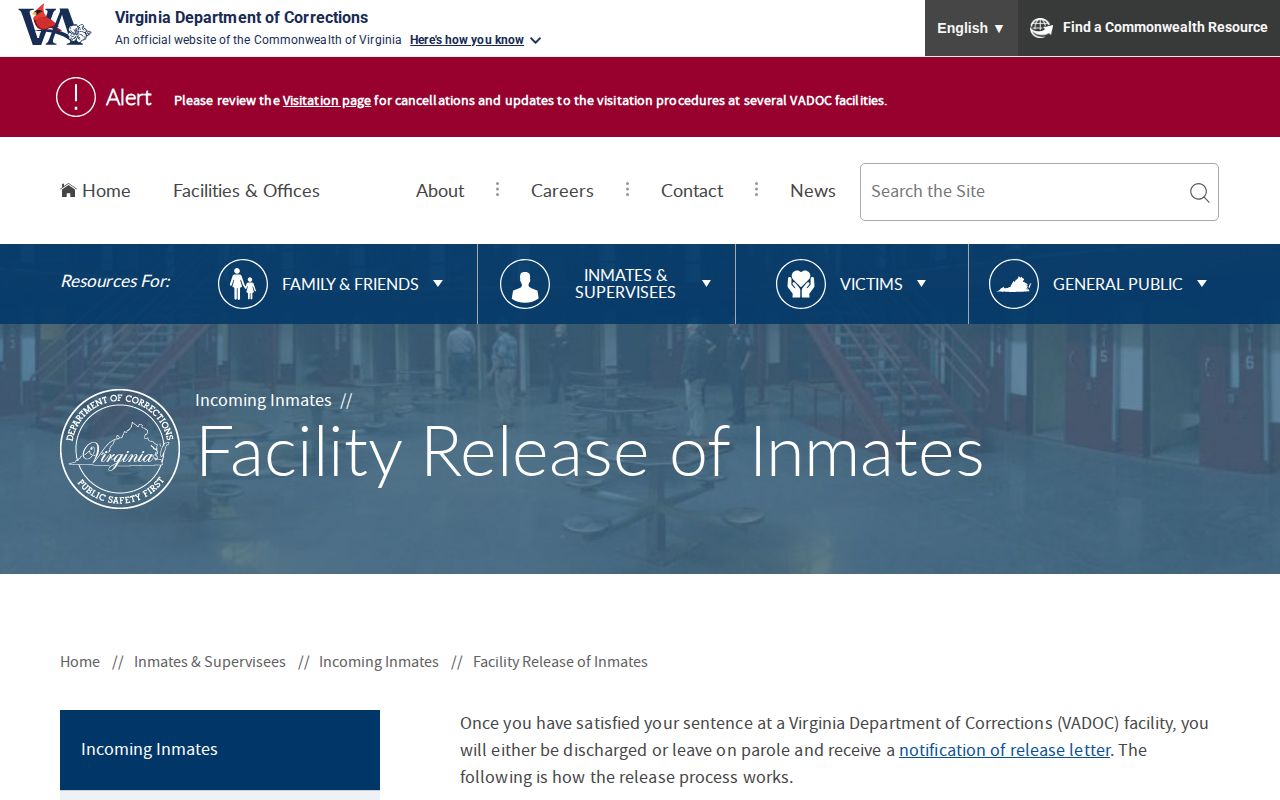
Those documents tie the calculated date to a completed state release and show whether probation or parole conditions follow.
Keep the end of physical custody distinct from final discharge. A district-office locator result can mean the person is out of prison but still under VADOC supervision. A receiving authority can also take custody on a detainer. In both cases, the projected state-facility date may have been met without ending every legal restraint.
No Universal Virginia 85 Percent
Virginia does not use one universal “85 percent” formula for every projected release date. Under the restricted ESC-1 maximum, 30 served days plus 4.5 credit days account for 34.5 days of a sentence. That works out to about 86.96 percent actual time at the maximum credit rate, not exactly 85 percent. Even that result applies only where the ESC-1 ceiling and top applicable level govern.
Eligible ESC-2 sentences can earn a different maximum, and actual rates vary by level. The statute’s ESC-1 offense list is detailed, so it should not be reduced to a broad label. The controlling conviction matters. When the calculation involves a violation, the underlying offense may matter too. Credit loss, restored credit, and updated source records can move the Caroline County projected release date after an earlier estimate was issued.
A sound check therefore starts with the sentencing order and the offense date, then asks which credit track VADOC has applied. The result should be read as of the day it is obtained. Family estimates can miss jail credit, consecutive terms, a lower credit level, or a later forfeiture. Even correct arithmetic cannot reveal an undisclosed detainer or replace the official computation. For a Caroline County state prisoner, preserve the DOC ID and the exact date label when requesting confirmation. For a Pamunkey sentence, direct the same question to the local record holder because the state formula cannot simply be imposed on a local calculation.
This calculation detail is the central Virginia-specific limit. It explains why two people with terms of the same length may have different dates and why a rough web estimate cannot substitute for the VADOC or local sentence record.
Older Caroline Good-Conduct Dates
The older Good Conduct Allowance system, called GCA, must stay separate from modern ESC. VADOC says parole-eligible GCA sentences generally involve felony offenses before January 1, 1995 and misdemeanor offenses before July 1, 2008. For active GCA or combined parole-eligible GCA terms longer than 12 months, VADOC calculates discretionary-parole eligibility, mandatory-parole release, and good-time release.
GCA classes can range from zero to 30 credit days per 30 served. Virginia Code § 53.1-199 and § 53.1-201 govern parts of this older system. A parole eligibility date under this framework is not the same as a mandatory release date, and neither proves that a release was completed.
Legacy parole rules add another date layer. Virginia abolished ordinary discretionary parole for most felonies committed on or after January 1, 1995, with defined statutory exceptions. For an eligible older case, the Board’s grant permits VADOC to begin the release process. It does not establish the physical departure date. The Board record, VADOC computation, and final release paperwork answer separate questions.
Operational rules can also affect the actual state-facility exit. VADOC requires warrant and detainer checks. Hazardous weather or a lack of safe public transportation can support a formally adjusted release, while arranged private transportation may permit release as scheduled. VADOC states that release occurs by 11:59 p.m. on the release date, weather permitting. That is a VADOC rule and must not be attributed to Pamunkey Regional Jail without a local source.
Note: Ask which calculation system controls before comparing a legacy sentence with a modern Virginia earned-credit case.